Wednesday, August 12, 2020

This is a statement which I wrote for our recent school newsletter:

 "Kia ora koutou katoa

Warm greetings to you all


Some of our school community have already heard the news that just over the week ago, I informed our Board of Trustees of my resignation as Principal of our school. While this has come as a surprise to some, it has been in my thinking and planning ahead for many months. 


I have been very privileged to be the Principal of Papakura High during a period of tremendous expansion and growth. Not just in numbers, but also in our school culture, levels of academic achievement and in the overall perception of our school in the wider community. Along with the rest of our staff, I can honestly say that we have much to be proud of. 


The Board of Trustees will be starting the process of recruiting a new principal for our school very shortly. This will be a very exciting time for our school. I have every confidence that there will be a strong field of applicants for the role, and that the successful candidate will work very closely with the school’s leadership team, the whole staff and the Board of Trustees to build on the school’s progress and move the school forward for the next phase of its development. 


After five years (the full time at high school of a “generation” of our students) it is time for me to move on to new challenges, and also to return to my home town of Otautahi- Christchurch, where my whānau is based. My departure is not only the end of my time as educational leader in this school, but it brings to a close over 40 years of working in varying roles in schools around the country. I have been very fortunate to have had a senior role as a Head of Faculty at Hamilton Boys’ High School for some years, as well as Assistant Principal at Lytton High School in Gisborne, Deputy Principal at Melville High School in Hamilton and Principal at Aranui High School in Christchurch for ten years before taking up my current role here in Papakura. I have treasured my love of teaching  and in the five schools in which I have been professionally active, I have always been looking to learn new things about teaching and learning. 


I have been contacted by many individuals since the announcement of my departure from Papakura High, and I have deeply appreciated all the kind messages I have received. It has been very difficult to make the decision to leave the school which I love and the community which I feel very much part of. I will miss my colleagues and students very much. However, there comes a time for all of us when we know we have given our best, and then it is time to move over for a new individual, with fresh energy and vision, to take over the reins. As I still have a number of months before I leave, can I assure you all that the next few months are very focused on the achievement of our NCEA students in particular, and that this message to you is not yet goodbye!


Ngā mihi mahana ki a koutou katoa"


Tuesday, May 12, 2020

CHOCOLATE

10 RANDOM THINGS I HAVE LEARNT  ABOUT LIFE ON  LOCKDOWN

  1. Toilet paper is the most  prized commodity in the country

  1. Things can always get worse!

  1. No one is coming to clean up the kitchen.

  1. A good book is one of life’s great  treasures.                         

  1. Being alive is glorious!

  1. There is no end to the new  learning we can engage in.

  1. Chocolate is the antidote to most evils.

  1. The room for improvement is the biggest room in the world.

  1. The difference between being bitter and being better is the I.

  1. Patience is the ultimate test of character!

Thursday, May 7, 2020

Today I clicked onto the New Zealand Herald to have a catch up on the latest news about the Covid-19 numbers and was instantly hit by something that has intrigued me increasingly regarding media practice and newspaper practice. That is the growing reliance on media commentators who express  views which are frequently politically influenced, who have carte blanche to churn out their predictable and tiresome views on a daily basis, which then appear to have a significant place in the way that the news and current events are presented.

What fascinates me in particular is that these individuals, featured here with their views about the government, are actually getting paid for this. I often wonder how they ever got to be in this position, given the quality of their journalism. I imagine that I could dream up a piece, related to some current issue, and then see what level of toxicity I could use, with which to present my opinion. While newspapers are wanting to ensure that a range of voices are heard in terms of commentary on important issues of the day, it appears that the more toxic or antagonistic the view, the more likely the press attention and coverage is achieved. This is a great shame, as in the past, newspaper columns had really balanced, insightful and thoughtful commentary, whereas now they simply expose the deeply held prejudices of the writer.

I'd like to suggest that readers should actually paid to read the sludge which appears in newspapers rather than paying for the privilege. At this rate, editors would be far more circumspect about ensuring that public commentary plays a balanced role among the news reports, and  would  aspire to publish newspapers which  contain quality journalism. At this point in time, I will happily put up my hand if an incentive could be offered and likewise happy to start paying once the current dismal, woeful standard of journalism is addressed.

Wednesday, April 22, 2020

THINGS ARE NOT ALWAYS WHAT THEY SEEM

This morning I have shared a few thoughts about an experience which I had  in my local park a few days ago which I entitled Things are not always what they seem. I hope you enjoy reading this little piece. I am very fortunate to live just a few steps from Hagley Park, one of the most magnificent public parks in the country. The early British settlers in Christchurch made it a priority in their very precise town planning, to allow for a wealth of public spaces. I am very privileged to be able to enjoy my life in Auckland and to still have a home base in the Garden City.


Sunday, April 19, 2020

TRIUMPHANT

PRINCIPAL’S SPECIAL BULLETIN No.4 

Monday 20 April 2020


Kia ora and welcome to this new week!


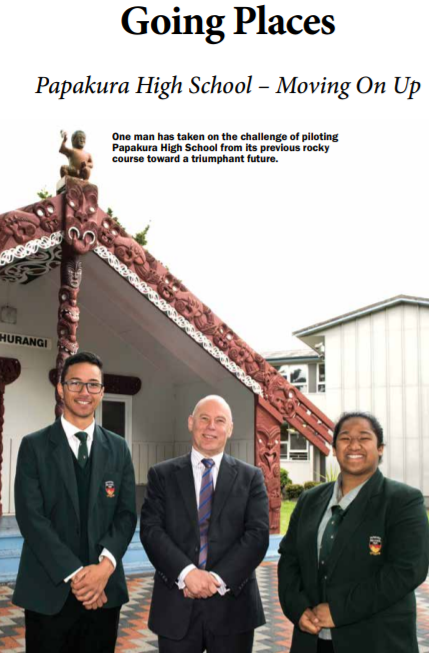
Over the weekend I found an “elocal” magazine in a box of memorabilia and the article which was included in it, from early 2016, gave me something to smile about. 
Apart from the fact that the photo is a lovely one of Roy and Moananoa, two of the head prefects of that year, it was a phrase related to the school’s future which caught my attention: “towards a triumphant future.”
In term 1 of this year, I sensed that our school was starting to get closer to this feeling of triumph than has been the case for quite some time. I know many of you have been feeling the same level of excitement as we have seen our numbers grow and grow. While we know there are a lot of challenges ahead of us, and that we will continue to face, we know that our school is flourishing. “Triumphant” is an unusual word to choose but it’s a word that gives me a little bit of a thrill when I read it. It’s a grand word, 
and it’s used in connection with our great and wonderful school. I get a thrill every time I walk into our 

staffroom and see the wonderful, clever and creative staff we have gathered together, who make such a vibrant and happy team. I get the same thrill every time I sit on the stage in our junior assembly and look down at hundreds of junior students, whose families have chosen to enrol them in our school. I guess that is “triumphant.” The list goes on...

Wednesday, April 15, 2020

IMAGINE

PRINCIPAL’S SPECIAL BULLETIN No.2 

Thursday 16  April 2020

IMAGINE

Many years ago, in the course of  a conversation with a very conservative Deputy Headmaster in the school where I was employed,  I made the suggestion that schools should be agents for social change. My colleague poured scorn and contempt on such a notion. I have never forgotten that conversation, and it has troubled me for the past 20 years. As time has gone by, I have become increasingly convinced that I am right about my notion, and that my colleague was wrong.

Schools have a powerful influence over social norms and behaviours in a number of ways. For sure, preserving the status quo and protecting the rights and entitlements of the privileged in our society is still very much the “kaupapa” of some of our schools. In our school, Papakura High School, we have an amazing opportunity to engage with our community and the society around us, to progress our pathway to becoming a bi-cultural society. This pathway will help to confront the deficits we see all around us in terms of social inclusion and engagement. The education which we offer our young people, our rangatahi, plays a big role in this. The changes we have made in our school’s own culture are the first steps in this direction. Our school motto “Kia Rangatira” is a power statement in this regard. This morning I struggled to remember the Latin motto “ Summa Pete”. 

For real change in our society  to occur, we need to turn some of our social norms on their head. Imagine if being bilingual became one of those social norms. The participants who make up our society must be able to see the value of overcoming social disengagement to be able to embrace something as radical as this.  As educators, we need to be at the forefront of this. We have opportunities to take steps to grow in this area. Many of our staff already come from cultural backgrounds where being bi- or trilingual is the norm. Our school can be an agent which contributes to positive social change and growth. There are naturally a number of ways this can happen. I have just identified one which I think can make a real difference right now. 


During the lockdown, Hemi Kelly’s “A Maori Phrase a Day” facebook page has repeatedly appeared on my phone screen. Hemi’s approach is very clear and basic, and offers an excellent opportunity to pick up and enhance your reo Maori in a really non-threatening and relaxed way. His lessons are also on Youtube.

I have really enjoyed dipping into Hemi’s facebook page and even reading some of the questions and answers which follow each lesson.
Our period of enforced lockdown provides us with a great opportunity to learn something new - or a lot of new things!


Tuesday, April 14, 2020

PRINCIPAL’S SPECIAL BULLETIN No.1 

Wednesday 15 April 2020


Welcome to the first day of Term 2 and to our new mode of teaching! We are all go today! I am looking forward with great excitement to hear the stories of these first encounters with our students via your digital classrooms. 

 Last week in our online meeting I mentioned being struck by this huge poster of Sir Edmund Hillary hanging in the arrival hall at Christchurch airport. It gave me a lot of food for thought.

There’s no question that the current context is one which throws into relief the incredible importance of our self-management skills, our ability to organise ourselves, our motivation, and our capacity to entertain the possibility of doing things differently. Many of us have been teaching for a long time. We have developed habits which are hard to shift. We have also developed approaches to our teaching, which in time, have become entrenched. I know this from first hand experience!  Some of us have allowed the wealth of professional learning related to digital pedagogy, which we have been offered as a Kootuitui school, to slide over us superficially, and have not made significant changes to our practice. Because we haven’t always been convinced of the need to change. Now of course, is the time when this is being forced upon us. Not just us, but teachers all over our country! Fortunately, we have colleagues who are hugely supportive, and whom I have sensed, will never be patronising or demeaning in their response to requests for assistance. And we are all going to require assistance in some area or other, as operating as an online school, or, in some transitional form, will require learning for all of us.

As human beings, “conquering ourselves” is enormously challenging. Sir Edmund Hillary made a profound statement here. Sometimes rousing ourselves to learn something new, or changing our practice, can be incredibly difficult. But as individuals working in an educational context, this is extraordinarily important. During our lockdown, we are also  having to face tests of character. These include coping in homes where children are becoming frustrated and bored, to supporting confused elderly and vulnerable whanau, or those like myself whose “bubble” is a solitary one. Develop our patience, tolerance and understanding of others is part and parcel of this process. For all of us, embracing change, however, is the biggest mountain we have to conquer, as we launch into our new  term. 

One lesson we have all learned, is how much we need each other. As a community of colleagues and  friends, there is much we have to offer each other from ou own experience and learning. And simply, in terms of social contact and emotional support. We have really exciting times ahead of us with new opportunities.   No reira, kia kaha, kia rangatira! 

Wednesday, April 8, 2020

A NEW DAY

A New Day


Today was a new day for the staff of Papakura High School. It not only marked two weeks since the beginning of the Covid-19 national lockdown, it was the first time ever that our whole staff got together - not physically present in one room, but on a Google hangout. Seventy faces all excitedly greeting each other and happy to be in the same space again. The world we live in is changing, and our circumstances are dictating different ways of doing business, doing school, and this was a landmark moment for us. Funnily enough, over the past five years, since the launch of the Kootuitui ki Papakura Trust and the first distribution of chromebooks for our year 9's, we have spent so much time engaged in professional learning, with not only the Manaiakalani mantra of "learn, create, share" but also with our own focus on creating ubiquitous learning for our students... maybe though, without the sense of urgency which was called for.  Thank you to the Kootuitui team for not giving up on us!

Somehow, until today, there was a theoretical aspect to this approach to learning. As teachers, we tend to be quite set in our ways - and yet we, of all people in our society and in our communities, should be at the forefront. Many are, of course, but there are equally many who lag behind. Well, no more of that, as next Wednesday we launch into our new day of online learning. Today we shared the joy of reconnecting with each other - it had a fun element to it, and along with its important messages, there was also the sheer joy of being together. Now now have the serious business ahead of us, firstly to connect with our students, and secondly, to hook them into a new style of learning.


Wednesday, June 12, 2019

Boards of Trustees elections

It's been a long time since I have posted on my blog and I feel a degree of embarrassment and shame about this! What's going on here?
Over the past few months all over the country, we have been preparing for Board of Trustees triennial elections. Boards of Trustees were one of the most positive outcomes of the Tomorrow's Schools' reforms which happened in 1989.  While unquestionably, there have been some unfortunate instances where the concept of Boards of Trustees has worked well for their communities: the "hijacking" of Boards by interest groups, strong minded individuals who have had personal agendas, Board members who have engaged in sustained conflict with the Principal, or not understood the dividing line between school management and governance. However, these have been the exceptions and Boards all around Aotearoa have functioned well with Trustees serving their school communities in the best interest of the students of their schools. STA - the School Trustees Association, has been a great support for schools as well as their Boards, in providing legal and industrial advice.

The issue which I believe  needs to be sorted before any changes are made to the structure of Boards of Trustees (proposed in the Taskforce Report commissioned by the Minister) is the form of voting which occurs and the focus on the importance of voting for the BOT. Attention needs to be given to the overwhelming non-engagement of large sectors of the community in the voting and election process overall. Questions need to be asked about a more effective way to hold an election rather than a postal ballot. While at my school there is a ballot box on the reception counter for parents and whanau to drop in their voting forms, it still appears to capture a very limited number of forms.

School Boards fulfil a vital and necessary role in giving communities a real voice in the character and direction of  the education of their young people. They have become a valued part of our social fabric.  The Ministry of Education and STA need to give potential changes to the make up of Boards very careful consideration. Unless they can demonstrate that these changes will enhance the governance model which Boards provide, they should leave well alone.

Sunday, January 21, 2018

CONTEMPLATING YEAR 40


It's hard to believe, but 2018 is my 40th year  as an educator in the New Zealand state school system. I fully intend to celebrate this milestone, by making sure every day at school is a significant day and that I achieve something fulfilling and satisfying. I began my teaching career at Lytton High School, Gisborne, at the beginning of 1979, which continued with positions at Hamilton Boys' High School, Melville High School, Aranui High School and most recently, Papakura High School. A year as Acting Principal at Melville High in Hamilton made me realise that to be a Principal was a most challenging and rewarding career pathway, and during that year was appointed to my first permanent principalship, at Aranui, which commenced in February 2006. Funnily enough, Aranui had been my final placement as a teacher traineee, and I accepted my first teaching position by sending a telegram to the Principal of Lytton High School from the now long gone Aranui Post Office.  Little did I realise that my life would go full circle and that one day I would return to the same school where I did my teacher training practice.

When I think about the 39 years behind me, I am very grateful for the opportunities which I have received. I have been able to work in both city and rural schools, single sex and co-educational. Those opportunities helped to give me a balanced view about schools and schooling, which it would be impossible to have, without moving around gaining the experiences which five vastly different schools have given me. Opportunities come our way from time to time in life, and I always urge teachers with the same thought: if the door opens, walk through it! How often in life we meet individuals who have regret and bitterness, because they did not take the opportunities offered to them. Maybe because they were too comfortable and settled in their situations, or maybe because of fearfulness of the risks of failure or fear of the unknown. In each school that I have worked in, I have learned something new, been able to make judgements about what I value, and seen ways of functioning professionally, which I would have never otherwise experienced.

So what are the most important learnings I have gained, as I embark on my 40th year in this amazing journey in education?

First and foremost, the importance of having a teaching vocation, in order to be happy in ones work and to finding meaning and enjoyment in the craft of teaching. Without an overwhelming inner compulsion to aspire to be an educator, a teacher will be at best an average individual who imparts curriculum content without the love and enthusiasm of the teaching craft, which can only come from a vocation. And while this may appear to be somewhat old fashioned or even dated in the 21st century, it remains as true as ever.  It is the constant factor which gives teachers resilience and the inner strength to survive the hard times. And which helps them to see beyond the difficult days to the better times ahead.

A love of working with young people, and taking an intense interest in their well being, is secondly, a precondition to success in teaching, and the longer I have been a teacher myself, the more important I have observed this to be. It did not take very long for me to realise, as a young teacher, that involvement in sport and other extra-curricular activities was critical to building the necessary bridge that would make the classroom a pleasure rather than an ordeal. Moreover, going "the extra mile" for students because they deserve it, and because you value them, is critically important.  I have found that young people are particularly discerning about the teachers in front of them, in terms of their recognition of a teacher's genuine interest and care for them. Those teachers who show their aroha, their care and love for their students, are creating the environment in which learning can flourish. Those teachers can see a group of individuals in front of them - not a class, not a crowd, but a group of individuals with vastly differing backgrounds and needs, all of whom need his or her individual attention and concern.

I have also learned that "the good teacher," the one who stand out from the crowd, is the one who is never satisfied with his or her teaching performance, but who aways strives to do better and to explore the boundaries of pedagogy.  As a teacher and as a principal, remaining  commited to self-improvement is an indispensible part of remaining vital and fresh professionally. This is an imperative irrespective of whether you are in your first or fortieth year of teaching.  Not only is the objective, improvement of teaching performance, and methodology,  but also an expansion of curriculum knowledge and  subject content. This commitment to professional growth becomes increasingly difficult for some teachers as they get older, and yet this is the time in ones career when it is most important of all.


Happiness, positivity, as well as personal transparency  as a teacher have often been recognised as qualities which are important for teachers. I have learned that all the technical and pedagogical expertise without emanating a sense of  personal identity  and wellbeing to students, makes learning a very clinical process. Students must be able to capture glimpses into the humanity of their teachers. Parker J. Palmer (from The Heart of a Teacher) called this "the inner landscape of a teacher's life." I've often wondered about the way some teachers seem to have this innate ability to make connections between themselves, their subject matter and their students. I have come to realise that teachers must learn how to project themselves personally into their teaching. That is when the magic occurs.

And of all the other insights which I have gleaned over the four decades behind me, there is one other, which in the context of Aotearoa New Zealand, is of greatest importance. This is the cultural awareness, openness and engagement, to successfully work in the context of an environment which is defined by Maori as tangata whenua of this country. Irrespective of whether you come from a white New Zealand/Pakeha background or where ever.  It is also defined by the multiplicity of other races that make up our classrooms, principally Pasifika, and then Asian and other migrant groups. There is a compelling mandate for those who work at the forefront of education, to actively grasp the opportunities to learn te reo Maori, to become proficient in their understanding of tikanga,  to become knowledgeable and skilled in their understanding of  Pasifika cultures and those of the other cultures they interact with, and to radiate an enthusiasm for those cultures in their every day dealings with young people. Long gone are the days when a simple "kia ora" was adequate to show this commitment. Teachers of 2018  must be modelling their learning of te reo Maori and leading the way, so that in future years the banal arguments about the use of te reo in the media and other public contexts will be long forgotten, as our country embraces its heritage. Teachers must be agents of social change that usher in a new era of being a bicultural nation in the spirit of Te Tiriti o Waitangi.

I have asked myself: "Should I have included my learning about technology in this list of the most important things I have learned?" As a teacher who has witnessed the most dramatic changes occurring in education thanks to the introduction of modern information technology, I think not. The same disposition to be a committed learner is  required to keep abreast of technological change as every other form of learning I engage in.  In my Teachers' College year we were required to pass an "Audio Visual Certificate" which meant being able to demonstrate the use of the banda machine, the Gestetner and the movie projector! I am profoundly grateful for the technology which we have at our disposal for bringing learning to life in the 21st century, and for the marvellous opportunities of ubiquitous learning which it creates. Nevertheless, everything I know about this will be obsolete in five years time!

I am grateful to many inspirational teachers whom I have encountered during my career. They have helped to forge my beliefs about this great profession. They have helped me to believe that we must never compromise our personal values and they have taught me so much. But most of all, it is the students who have passed through my classroom, and more latterly, through my office and a through a multiplicity of other contexts, who have taught me the most. It is to them I owe my biggest thank you.



Wednesday, October 25, 2017

Students forging a new future identity

What's in a logo? When you think about the purpose of a school crest or logo, you realise that this image is actually a very powerful symbol which represents some key idea, notion or value related to the identity and history of a school.

Papakura High has a logo which of course was designed for the opening of the school in 1954, which portrays an image of Mount Everest. The close connection of Sir Edmund Hillary with the Papakura region has meant a number of schools and organisations have made use of this in their logos and visual features. Accompanying the logo is the Latin motto "Summa pete" meaning "Seek the Highest."  More than half a century has passed since then, and the students of Papakura High, who comprise a very different community to that of the foundation students of Papakura High School, struggle to see any connection with the logo and the Latin motto.

At the beginning of this year, as part of our whanau development, students were elected to form a body which would provide a voice for the students of our school, and which would empower them to take on a role in forging a new identity for our school. This group is known as Te Kaunihera a Akonga -  the Student Council. I see the formation of this student team  as a critical step forward in helping our students take ownership of their school. Over the past months, they have had numerous discussions and brainstormed their ideas about the kinds of images which they think would best suit the Papakura High of today, and into the future. These 30 students (ten  from each whanau) have come up with a wealth of ideas and images. They have been excited about their role in shaping the future, a responsibilty which they greatly appreciate. They understand the importance and value of traditions, but they also want to be part of a future focussed school which will serve both them and the next generation and want the logo to signal this. 

This process has now moved to the next stage - the school has engaged a graphic design firm with experience in this area, to assist a sub-committee of Te Kaunihera a Akonga. In a few weeks the designers, who have been delighted with the input and creativity of our students,  will present them with their first range of images from the concepts discussed. Our students will hugely benefit from their involvement in this iterative process - the learning about the phases of design work. Who knows where this might lead our students in their own future pathway?


The school's logo representing Mt Everest


Sunday, September 10, 2017

TE WIKI O TE REO MAORI

Kia ora tatou!
Kua timata te Wiki o te Reo Maori! Kei te mihi ahau ki te reo tuatahi o Aotearoa. He mihi hoki ki a koutou e tautoko ana te kaupapa o te wiki nei.

There are few issues as contentious as the place and role of Maori language in the wider life of Aotearoa New Zealand at this time. Calls for te reo Maori to be compulsory in schools are gathering momentum, and are equally being resisted by certain quarters in our society.

What makes this issue all the more contentious is the fact that this country, compared to most, is remarkably mono-lingual. It is the norm in most countries around the world for two, three or even more languages to be spoken on an every day basis. My observation is that resistance to bilingualism is most fierce on the part of monolingual Kiwis who come from a colonial background, who make up a very large proportion of our society and who believe that English somehow has legitimacy in replacing te reo Maori as the most important language in our country.  This is also reflected in the political views of certain parties and politicians. I've been reading comments in the social media such as "Maori is a dead language," "Learning Maori is a waste of time as it's only spoken in New Zealand," "Non-Maori should be forced to learn Maori."

The reality is otherwise. Te Reo Maori is an official language of Aotearoa New Zealand and has the rights and status to be spoken everywhere, and as such, should be learned by all Kiwis. Te Reo Maori is what distinguishes this country from Australia and other English speaking countries. It is the language of the tangata whenua of our country and should have pride of place as a unique taonga or treasure, to be nurtured and fostered by all. As a Pakeha school principal, it is my special responsibility to ensure that I do everything I can to ensure my school community is committed to this.

In our school context, we will be promoting the learning of te reo Maori in a range of different ways over the next year. We have started to introduce a new culture into the life of our school which incorporates Maori terminology at every level. We have liaised with our local iwi Ngati Tamaoho, who have very kindly provided us with names of great cultural significance to Tainui, for our three whanau.  Our Board of Trustees will be embarked on a language revitalisation programme as well. As the majority of the students in our school are of Maori descent, it is appropriate that their cultural identity is affirmed and enhanced by the school.

Our school marae is a place where te reo Maori is respected, and where powhiri occur, which are conducted entirely in this language, which reflects its importance and and status. We are very fortunate as a school to have this sacred and culturally significant place as the heart of our school.

Te Wiki o te Reo Maori is not just another week in the calendar. It provides a wake up call for our society that it is time that all members of our society acknowledge and embrace this treasure.

No reira, he mihi ano ki tenei taonga tuku iho.


Detail from Te Kahurangi, the wharenui o Papakura High School.

Monday, March 6, 2017

"Under the Bridge"

In February of this year, thanks to a team of investigative journalists from the New Zealand Herald, Papakura High School has been thrust into the forefront of the  media because of a feature film which follows a year in the life of three of our senior students plus myself as the newly appointed Principal.
The film was also preceded by four short promo films focusing on each identity in the film, and then with a 3 day follow up in the printed New Zealand Herald (front page on day 1, highlighting my message of hope for Papakura High School.)

The film can be viewed online at  NZ Herald Under the Bridge
The background to the film and the response to it also make interesting viewing.

One of the unexpected consequences of the film has been the contact which the school has had from former students from all around the world. This has been quite exceptional. In some instances we have received generous gifts from them, with most insisting on anonymity.

We have also had a number of alumni contact the school with a view to setting up an active alumni group and also to setting up a Charitable Trust, whose object is to provide for the well being of Papakura High School students and also to provide enrichment opportunities for them, which the school could never hope to provide out of its means. We are thrilled with this outcome.


The team from the New Zealand Herald and the Papakura High team of Jayden Schell, Robert Downes and Wendy Savieti and I posing after the final shoot for "Under the Bridge"


Wednesday, May 4, 2016

OUR SECRET TEACHER'S REPORT

Junior students receiving progress awards at term 1 Achievement Assembly.
Kirsty Johnston from the New Zealand Herald has been doing a series of investigative pieces on Primary Schools and the issues related to the achievement of children.

The whole series is available online at: tinyurl.com/ThePrimaryIssue


I have been following this investigation with great interest, as it has been taking a hard look at how and why children at primary school achieve or don't achieve. The spotlight is on National Standards, whose introduction was a political initiative, designed to raise achievement.

One of the most strident objections to National Standards is that the starting point for children at their enrolment point varies enormously in terms of what they are already capable of, particularly in their language development. Kirsty Johnston's feature highlights the fact that while some children can barely count to five when they start school, or have never held a pencil, they can speak another language, such as Samoan or Tongan. This lag in early school expectations, which doesn't correlate to intelligence, follows many children throughout their eight years of primary (or primary and intermediate) education, and through into secondary school.

The objection focusses on the fact that National Standards do not measure  how far a child has progressed in their learning from their starting point. These children arrive at secondary school, with the expectation that by the end of Year 10, they will be capable of commencing their first year of NCEA. The political mandate is centred around students achieving NCEA Level 2 by the time they turn 18. This is irrespective of the ability level  at which they started their secondary schooling. The philosophy behind National Standards dooms many children to failure well before they arrive at secondary school, as they are being measured according to their ability to reach an established standard of academic competence, not how far they have progressed in their learning from where they started.  NCEA follows the same pattern.

Once students reach secondary school, their academic achievement contributes to the overall profile of NCEA results, which are published nationally. In the eyes of the community, the school's reputation is determined by these published results. Naturally, every school works extremely hard to support students achieving to the highest level. Students are challenged to work to the best of their ability to achieve, irrespective of the point at which they started. Fundamentally, many students whose primary school experience was one of never reaching the standard, and being categorised as failures in the particular criteria which are being measured, will have a tough time in overcoming this stigma at secondary school. During my time as a secondary school principal, I have been inspired by many outstanding teachers who have encouraged and challenged students to be successful, and to achieve to a high level, despite this stigma. I have likewise been inspired by the students whose sucess flies in the face of the expectations of failure, which National Standards have reinforced.


Tuesday, March 29, 2016

TECHNOLOGY AND STUDENT VOICE

Over recent weeks staff have had the opportunity to participate in a range of toolkit workshops and sessions on enhancing their digital pedagogy. These have been greatly appreciated.

I am struck by the fact that the relationship between teacher and students is greatly enhanced when digital tools are being used as part of the pedagogical process.

I recently read a quote in a text that has intrigued me, entitled Technology Integration and High Possibility Classrooms, by Jane Hunter (Routledge 2015) The quote reinforces what I have been observing in the workshops I have attended: "Technology gives reluctant learners a voice, the student who is not confident or who is not engaged can suddenly be good at something - when they develop their ideas, they can produce something using technology. It doesn't always have to involve technology, but more often it does. The product can then be praised by the teacher." (p.99)

The fact that teachers and students can interact and engage in learning outside of the confines of the school day and environment using Google apps also impacts on that relationship, as both can be in their own space and collaborate at a time that suits. I am very grateful to the staff who are helping their colleagues gain the confidence to be effective in their use of this relationship enhancing technological tool.